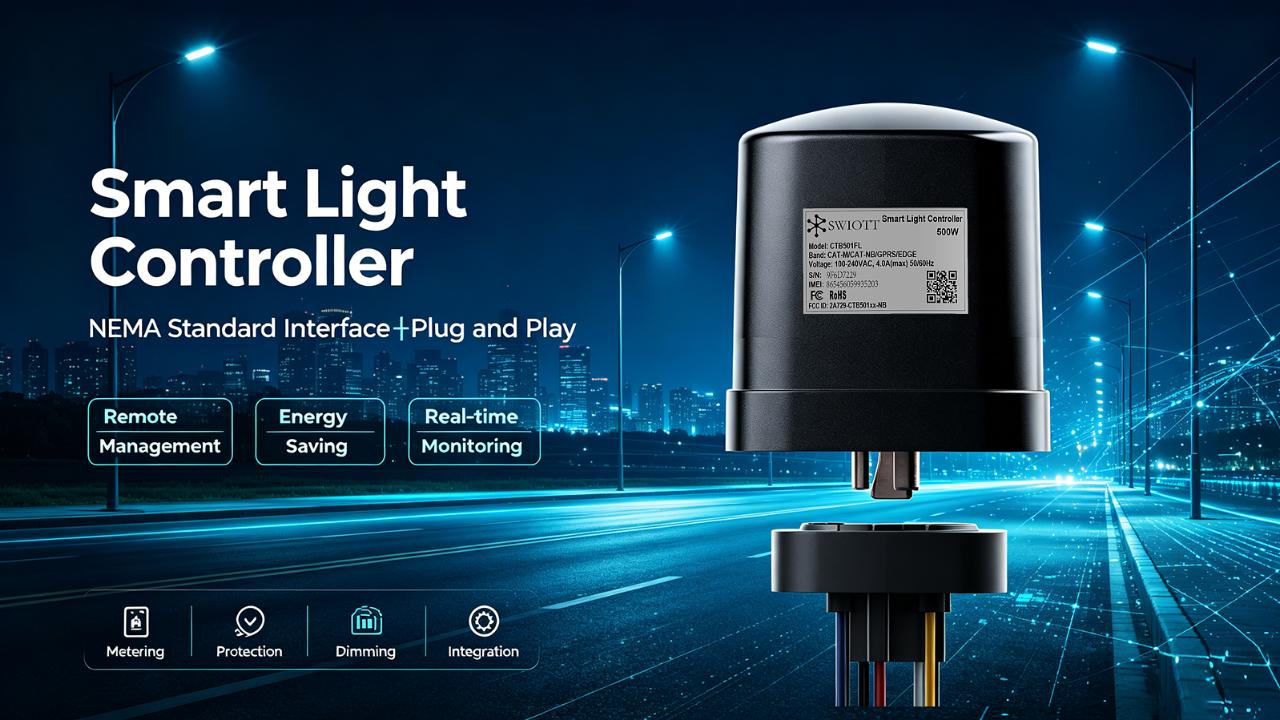
Most municipal lighting retrofits start the same way. The poles already stand, the luminaires already work, and the brief asks for two things: know which lamps are on, and see how much energy each one uses. Without a controller at the pole, the operation is still a paper exercise: a dark stretch is reported by phone, energy is billed on a whole-zone meter, and a tilted or damaged pole is noticed only after it becomes a safety complaint.
That is the gap an NEMA smart street light controller closes. Mounted on the luminaire's standard seven-pin NEMA receptacle (ANSI C136.41), it reads the fixture locally, reports back to a central platform, and receives commands that dim, switch, or schedule the pole. This guide covers what such a controller does at the pole, how the three communications routes compare, and what data the cloud layer needs.
The communications route gets the most attention in a selection meeting, but the pole-level functions decide whether the system delivers value. Four functions appear in a working installation.
Real-time electrical metering. As a street light energy monitoring controller, the unit reads voltage, current, power factor, and cumulative energy at the individual pole, rather than leaving the project with a zone-level bill. That is the baseline for energy benchmarking, spotting a faulty driver before the lamp fails, and answering which fixtures are consuming more than they should.
Continuous online status. A monitored pole reports its connection state on a regular heartbeat. Maintenance then sees the difference between a lamp that is offline, a controller that is offline, and a radio path that has closed — instead of treating all three as the same fault.
Tilt and structural alerts. A street light controller with tilt sensor detects that a pole is leaning and sends a tilt alert to the platform before the pole fails. For municipal and campus assets this turns a structural risk into a scheduled inspection rather than an emergency response.
Scheduled and light-triggered switching. The pole switches on at a set time, or when ambient light drops below a level, and follows a dimming profile through the night. Group and broadcast commands let a zone follow one schedule without visiting each pole.
Shared hardware baseline across the range. All three variants run from 100–277 Vac, support 0-10V, PWM, and DALI dimming, and use an IP66 sealed housing for pole-top mounting. The metering channel covers voltage, current, power factor, and energy; the hybrid CTN501 is specified at 1% metering accuracy. A three-axis gyroscope provides tilt and collision alarms, a built-in photocell handles dusk-to-dawn switching, and GNSS positioning is optional for asset tracking.
Beyond these, the platform layer collects what the pole sees: electrical parameters, pedestrian and vehicle flow, and geolocation, so a dashboard can place every registered device on a map and control it from one system. Staged lighting, a row coming on two poles at a time, is one visible result of that central control.
The controller family splits by how it talks upstream. The right choice follows the site, not the vendor's preference.
LoRaWAN. A LoRaWAN street light controller joins a private LoRaWAN network through a gateway, which forwards nodes to the platform. It suits dense clusters on a campus, a city district, or an industrial park where one gateway can cover many poles. Recurring SIM costs stay low, but the network is owned or shared by the integrator, including gateway placement and range planning.
Cellular. A cellular street light controller connects directly to a public cellular network over NB-IoT, CAT-M, or GSM. It suits scattered poles on a rural highway, a long corridor, or a site where running a private gateway is uneconomical. Deployment is simpler because no local radio planning is needed, but each pole carries a subscription and coverage depends on the carrier.
PLC+LoRaMesh hybrid. A PLC LoRaMesh hybrid street light controller keeps both a power line carrier and a mesh radio in the same enclosure and selects the route per message. It suits sites that mix difficult conditions: transformer boundaries, heavy feeder noise, blocked radio paths, tunnels, and port or industrial areas. The trade-off is slightly higher cost per node and a two-transport design to maintain; the payback is a segment that degrades slowly instead of disappearing.
| Criterion | LoRaWAN (CTW501) | Cellular (CTB501) | PLC+LoRaMesh (CTN501) |
|---|---|---|---|
| Typical fleet shape | Dense cluster, campus, district | Scattered poles, long corridor | Mixed or hostile urban and industrial sites |
| Network owned by | Integrator / project | Mobile carrier | Integrator, existing feeders plus mesh |
| Recurring cost | Minimal, no per-pole SIM | Per-pole subscription | Minimal per-pole, gateway per zone |
| Load capacity | 500W, 4A | Up to 1000W, 4A | 500W nominal, up to 1000W |
| Dimming and protection | 0-10V / PWM / DALI, IP66 | 0-10V / PWM / DALI, IP66 | 0-10V / PWM / DALI, IP66 |
| Best when | Many poles under one gateway | Few poles, no gateway justified | Noise, boundaries, obstruction coexist |
The pole device is only the source. The smart street light monitoring system turns the uploads into an operational view: asset list with location, online and offline state, per-pole energy and power, flow counts where the fixture sees people and traffic, and alarms such as tilt, over or under voltage, and driver faults.
That view matters most for groups. A remote street light control system can switch or dim a whole zone, publish one schedule to all registered devices, or bring a row online in stages. For a smart city rollout it replaces spreadsheet dispatch with a map-first work order: the alarm names the pole, the meter reads out, and the crew goes to the right location.
Where a presence sensor is fitted, the lighting can later follow activity instead of a fixed clock.
The SWIOTT NEMA range follows the C136.41 seven-pin socket standard, so it twists onto the luminaire without rewiring: the CTW501 LoRaWAN controller for dense private-network clusters, the CTB501 cellular controller for scattered poles, and the CTN501 PLC+LoRaMesh hybrid for mixed and hostile sites. The wired, terminal-block variant of the hybrid route is the separate CTNL501 / CTWL501 / CTBL501, which is a different product from this NEMA line. The pole-level functions — metering, tilt alert, scheduled and light-triggered switching, and grouped control — are shared across the range. For a deeper look at how the hybrid route handles dead zones, read the dual-mode PLC and LoRaMesh guide. For solar-powered poles, the solar street light controller with LoRaWAN or Cellular guide covers the energy-storage side.
Q: What is an NEMA smart street light controller?
A: It is a controller that mounts on the luminaire's standard seven-pin NEMA C136.41 receptacle, reads local electrical data, reports to a central platform, and receives switching or dimming commands over LoRaWAN, cellular, or a PLC+LoRaMesh hybrid route.
Q: LoRaWAN or cellular for a new lighting project?
A: Dense fleets under one gateway usually favour LoRaWAN for lower recurring cost. Scattered poles and corridors with no private network usually favour cellular, which trades a per-pole subscription for simpler deployment.
Q: What data does a controller send to the cloud?
A: Electrical parameters, power and energy, online status, location, and alarms such as tilt; pedestrian or vehicle flow where a presence sensor is fitted.
Q: Can the platform control several poles at once?
A: Yes. Group and broadcast commands apply one schedule or one dimming level to every registered device in a zone, which is how staged and row-by-row lighting is executed.
Q: What is a tilt alert used for?
A: The controller detects that a pole is leaning and raises an alert on the platform, so structural inspection is scheduled before the pole becomes a failure or a safety hazard.
Q: How does the lamp know when to switch on?
A: On a schedule set in the platform, or from the local ambient light level. It can follow a night dimming profile after switch-on instead of full brightness all night.
A controller choice made on price alone usually surfaces as a coverage problem after commissioning. Map the poles first: where they cluster, where they scatter, what noise and boundaries the feeders carry, and what data the city expects to see on the dashboard. Our engineering team can review the fleet layout and suggest which of the three communications routes fits each segment. Reach out to discuss a specification review or a pilot zone.


